TWEET

Showing posts with label British Sky Broadcasting. Show all posts

Sunday, 24 October 2010

MEDIA STUDIES: INSTITUTIONS - THE MURDOCH EMPIRE

0 comments

Rupert Murdoch hits back at opponents of

  News Corp bid for BSkyB

Rupert Murdoch delivering Thatcher lectureChairman and chief executive of News Corporation Rupert Murdoch delivering the inaugural Baroness Thatcher lecture. Photograph: Arthur Edwards/ReutersRupert Murdoch has hit back at rival UK media organisations opposed to News Corporation’s bid to take full control of BSkyB, branding them “small thinkers” trying to place “restrictions on growth”.
Delivering the inaugural Baroness Thatcher lecture last night, Murdoch, the News Corp chairman and chief executive, said this was an “issue for my company”.
Murdoch did not talk directly about his company’s bid to take full control of BSkyB, the satellite TV company in which it already holds a 39.1% stake. An alliance of media owners, including the Daily Mail & General Trust, Telegraph Media Group, BBC and Guardian Media Group, which publishes the Guardian, has called on business secretary Vince Cable to block the deal on public interest grounds.
However, it was clear what he was aiming at in the following passage of the speech: “We must celebrate a culture of success. The rise to prominence is too often accompanied by a surge in cynicism by the traditional elites.
“I am something of a parvenu, but we should welcome the iconoclastic and the unconventional. And we shouldn’t curb their enthusiasm or energy. That is what competition is all about. Yet when the upstart is too successful, somehow the old interests surface, and restrictions on growth are proposed or imposed. That’s an issue for my company. More important, it’s an issue for our broader society.
“These are the small thinkers who believe their job is to cut the cake up rather than make it bigger.”
Murdoch also said that one of the factors that would help make Britain successful in the 21st century would be “corporate and technological sectors that thrive on change, and use the freedom of the market to innovate and grow”.
The media mogul made a veiled reference to the phone-hacking scandal that has engulfed his Sunday tabloid, the News of the World.
“Our new world is one of modern mass communication, phone and text, without limit. Democracy will be from the bottom up, not from the top down. Even so, a free society requires an independent press: turbulent … enquiring … bustling … and free,” Murdoch said.
“That’s why our journalism is hard-driving and questioning of authority. And so are our journalists. Often, I have cause to celebrate editorial endeavour. Occasionally, I have had cause for regret. Let me be clear: We will vigorously pursue the truth – and we will not tolerate wrongdoing.”
Murdoch and other News Corp executives have maintained there is no evidence of widespread phone hacking at the News of the World.
He insisted earlier this month that it was limited to the paper’s former royal editor, Clive Goodman, who was arrested for intercepting voicemails left on mobile phones belonging to members of the royal household in 2006. Andy Coulson, who is now David Cameron’s communications director, resigned as News of the World editor when Goodman was jailed in January 2007.
Murdoch also made the case for the continuing importance of traditional journalism, while admitting that bloggers have a role to play.
“It would certainly serve the interests of the powerful if professional journalists were muted – or replaced as navigators in our society by bloggers and bloviators,” he said.
“Bloggers can have a social role – but that role is very different to that of the professional seeking to uncover facts, however uncomfortable.”
Bookmark and Share
Enhanced by Zemanta

Saturday, 23 October 2010

MEDIA STUDIES: INSTITUTIONS - THE MURDOCH EMPIRE

0 comments
Bookmark and Share

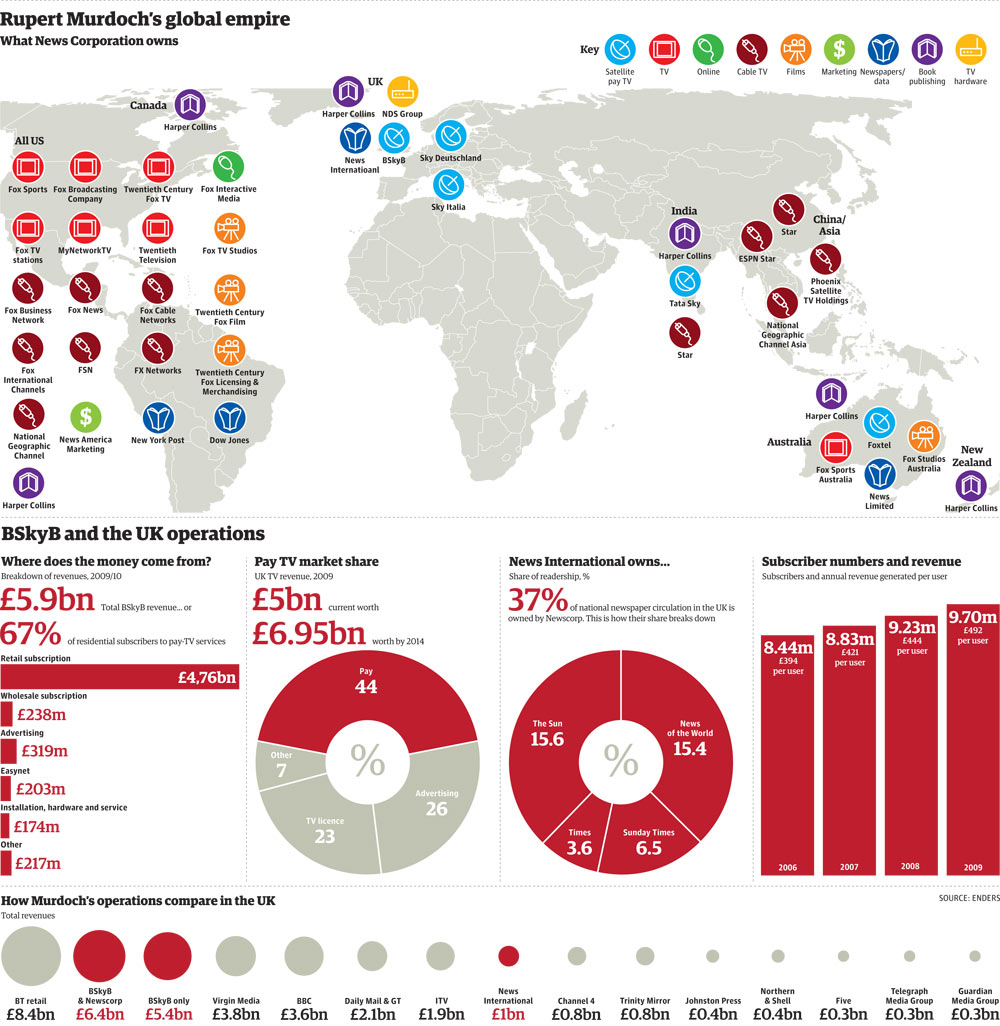
Rupert Murdoch - World Economic Forum Annual M...Image via WikipediaRupert Murdoch and BSkyB: how powerful would a takeover make him?

Rupert Murdoch wants to own all of broadcaster BSkyB. If he gets his way, the shape of British media could change forever, according to a leaked report. See what the data says
• Get the data
Rupert Murdoch and BSkyB graphic View larger picture
Rupert Murdoch and BSkyB broken down. Click image to get graphic. Illustration: Finbarr Sheehy for the Guardian
Rupert Murdoch is keen to buy up the rest of BSkyB - he presently controls 39.1% of the company which is increasingly dominating British broadcasting.
memo signed by a coalition of British media companies, including the Guardian, asks Business secretary Vince Cable to refer the proposed takeover to Ofcom.
So, if Murdoch succeeds, just how powerful would he become in the UK? According to a confidential report from respected media analyst Claire Enders to Vince Cable - subsequently leaked to media site BeehiveCity - it would substantially change the British media landscape.
Allowing the deal to go through would amount to Britain's 'Berlusconi moment'
You can download the leaked report at the site and it includes tonnes of data and a damning final verdict on the proposed takeover.
The key points are, according to Enders:
Products currently separately offered by BSkyB and News Corp titles may be combined in bundles… Strategic initiatives of this nature could lead to a much more rapid decline in competitor newspaper circulations than we have assumed, boosting News Corp's newspaper market share above 40% by 2014…
…Stories from Sky News (especially video) will presumably be carried more and more frequently on News Corp websites … Progressively, News International papers and BSkyB channels, particularly Sky News, may merge into one stream of fact and opinion. If this occurred, plurality would decline, even if the combined organisation continued to maintain newsrooms that are nominally separate…
…The loss of the independent BSkyB shareholders will allow News Corp greater opportunity to influence, tacitly or otherwise, the editorial coverage of Sky News and other BSkyB channels…
The final point is perhaps the most serious:

We believe … that there is a risk of a reduction in media plurality to an unacceptably low level
We've extracted the key data from the report for you below - plus a list (probably not exhaustive) of News Corporations' operations, from the group's website. We've visualised it above (click on the image to get the graphic).

Enhanced by Zemanta

Saturday, 28 August 2010

MEDIA STUDIES: INSTITUTIONS

0 comments
Bookmark and Share

Courtesy of the Guardian.


BBC’s Mark Thompson takes aim at Murdoch empire in MacTaggart lecture

Mark Thompson and James MurdochMark Thompson and James Murdoch. Photograph: Murdo MacLeod/PAMark Thompson, the BBC director general, launched a scathing attack on Rupert Murdoch’s media empire tonight, warning thatBSkyB is too powerful and threatens to “dwarf” the BBC and its competitors.
Delivering the annual MacTaggart lecture at the Mediaguardian Edinburgh television festival, Thompson rounded on Sky’s chairman, James Murdoch, who used the same speech last year to attack the corporation.
“A year ago, James Murdoch fretted aloud about the lamentable dominance of the BBC,” he said. “He was able to do that only by leaving Sky out of the equation.”
Thompson said Sky was “well on its way to being the most dominant force in broadcast media in this country”.
He said that News Corp, in effect controlled by the Murdoch family, now enjoys unprecedented industry power in the UK. News Corp owns 39% of Sky and is in the process of buying the part of the broadcaster it does not already own.
“If Sky’s proposal to acquire all of the remaining share in Sky goes through, Sky will not just be Britain’s biggest broadcaster, but a full part of a company which is also dominant in national newspapers as well as [being] one of Britain’s biggest publishers,” Thompson said. That would be “a concentration of cross-media ownership that would not be allowed in the United States or Australia”.
In a sideswipe at the Murdoch press he also criticised newspaper coverage of the BBC, claiming: “Some newspapers appear to print something hostile about the BBC every week … the scale and intensity of the current assaults does feel different.”
Thompson also attacked Sky’s content, conceding that it had spent heavily on news and sport but saying it had failed to invest enough of its £4.8bn subscription revenues in British programming. He said Sky should be forced to pay ITV, Channel 4 and Channel 5 a fee for carrying their channels on its satellite platform through a “retransmission” charge.
That money could be used to invest in original UK programming, plugging a £300m funding gap that Thompson said had emerged since 2006 as advertising revenue has plunged.
He said Rupert Murdoch had argued in favour of a similar levy in the US, where News Corp owns the Fox channel. “He’s winning the argument,” Thomson said. “Fox is now receiving distribution fees from the cable companies. So why not introduce retransmission fees in this country as well?”
That could raise approximately £75m for commercial terrestrial channels whose revenues are under pressure because of an advertising recession.
“James may quibble with Rupert’s logic,” Thompson said. “I find it strangely compelling.”
In last year’s MacTaggart lecture James Murdoch accused the BBC of mounting a “land-grab” and described its ambitions as “chilling”.
Thompson responded by insisting that the BBC had never been so popular, citing research which showed that British television in general is highly valued by licence-fee payers.
“The purists have spent a generation making the free market case for abolishing the licence fee,” he added, in a thinly veiled reference to the Murdochs. “The British public agree with them less now than they did when they started.”
He continued: “Across the UK population, 71% of people say they’re glad the BBC exists.” Those figures were the same for readers of the Murdoch press, he said. News Corp owns the Times and the Sun as well as the Sunday Times and News of the World. He said the figure for Times readers was 83% and for Sunday Times readers 85%.
“I believe that the reason they have little traction on this subject is because their readers are able to compare what they read about the BBC with their own experience of the BBC’s services, week in, week out.”
Thompson also signalled that recent proposals to close the BBC’s generous pension scheme to staff would not be reversed, insisting that the corporation was “not afraid to shed the last vestiges of its bureaucratic past”.
He said he would remain in his post to negotiate the next licence fee settlement with the government next year. “Do I have the commitment and the energy to lead the BBC to where it needs to get to next? My answer is an unequivocal ‘yes’.” He added that he was “up for the fight”.
A spokesman for BSkyB said: “Mark Thompson has had a year to reflect on widespread and legitimate criticism of the governance of the BBC, its value for money and the effect its size is having on commercial competitors.
“He has failed at any point to address the impact that the scale and scope of the BBC’s activities is having on an all-media digital marketplace, which is worrying for the future of independent journalism.”
Enhanced by Zemanta